The continent contends with the most severe security crisis since World War II, fundamentally reshaping geopolitical calculations. The full-scale invasion of Ukraine reprogrammed the entire European defense architecture. The words of Dutch Prime Minister Mark Rutte — “We are not at war. But we are certainly not at peace either” — capture the new European reality.
That shift is visible in numbers: between 2021 and 2024, EU defense spending surged by over 30%, reaching €326 billion in 2024 alone. As Karmen Laus shared with us, before 2022 the EU largely relied on soft power and crisis diplomacy. Now, military deterrence and collective security are central to its external policy. This vision is echoed in the European Defense Agency 2024 CARD report, which urges Europe to address serious gaps in its high-intensity warfare capabilities. Concepts that once seemed distant—joint procurement, industrial rearmament, integrated logistics—have now become operational frameworks.
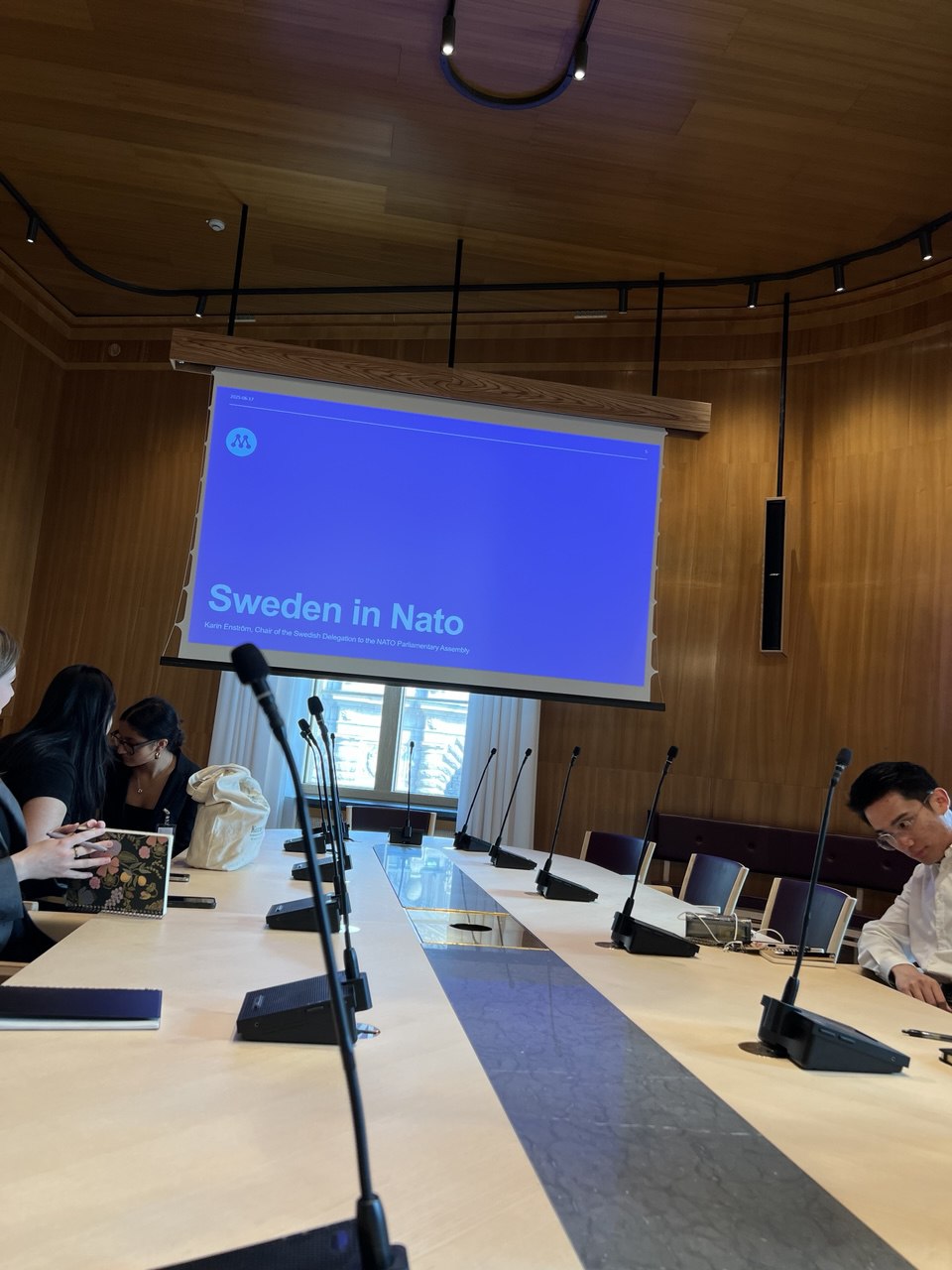
A glimpse into that future was offered to us by Karin Enström. The Former Defense Minister of Sweden noted: “Security and rebuilding of Ukraine is the highest priority when it comes to the Foreign Policies. They are fighting not just for their citizens, but for our safety and peace as well. If we don’t stop Russia now, Putin will come back later.” That stark warning reflects a broader truth: Europe is scared. And it is acting with Ukraine at the center.
The SAFE Act, adopted in May 2025, lays the groundwork. It introduces a €150 billion financial framework to support common procurement among the EU and partner states, including Ukraine. SAFE enables joint acquisitions of critical systems such as missile defense, cybersecurity platforms, and C4ISTAR technologies. More Broadly, SAFE serves as the first pillar of ReArm Europe, a sweeping modernization agenda that envisions €800 billion in defense investments by 2030. It signals Europe’s strategic pivot: away from U.S. dependence and toward its own collective readiness. For Ukraine, these programs mean something more immediate—access, integration, and opportunity. They open the door for new joint productions, shared innovation, and defense interoperability.
It’s no secret that Ukraine’s military capabilities surprised even the well-known defense leaders.
“Ukrainians are playing it smart, innovative. We all should be learning from such a fast development. Sweden is struggling with adaptivity, maybe we should take some tips from Ukraine,” Karin Enström reflected during our conversation.
Since 2022, the EU Military Assistance Mission has trained more than 60,000 Ukrainian troops. As Ambassador Vsevolod Chentsov told European Defence Matters, Ukraine is now shaping EU military doctrine through knowledge transfer, battlefield-tested tactics, and joint unit development. “When we win this war,” Chentsov said, “there will be many more areas of defense cooperation with the EU.”
While the finish line of this war is still uncertain, the political roadmap is coming into focus. As Karmen Laus explained, “Negotiations regarding EU membership are ongoing, but it’s a long process. We all know what we have to do. It’s their membership. While also, Ukraine in NATO would equal peace for all of us.” This vision is not just diplomatic optimism—it is being actively constructed.
According to a 2024 Bruegel report, Ukraine is seen as an “affordable arsenal for European democracy,” producing drones, armored vehicles, and ammunitions at scale and competitive prices. The European Commission’s 2025 White Paper on Defense echoes this view, calling for “enhanced support for Ukraine” and advocating its deeper integration into Europe’s defense industrial base. A dedicated EU-Ukraine Task Force launched this year is now accelerating this process—coordinating procurement projects, boosting co-production, and laying the groundwork for joint arms manufacturing in Ukraine.
Military alignment is progressing as well. NATO’s Comprehensive Assistance Package is already standardizing Ukraine’s forces to match Allied doctrine. Through training programs, interoperability reforms, and logistical planning, Ukrainian brigades are being prepared to seamlessly operate alongside NATO forces. RAND analysts suggest this will allow Ukraine, once a NATO member, to serve as a forward-operating stronghold for collective defense on the eastern flank.
Infrastructure tells the same story. The EU has officially incorporated Ukrainian corridors into its Trans-European Transport Networl (TEN-T), ensuring the key routes—from Poland through Lviv to Odesa—will be upgraded for dual civilian and military use. In the future, these links are intended to form part of Europe’s strategic mobility backbone, capable of rapidly moving troops, equipment, and supplies across the continent. EU Mobility Action Plans from 2023 and 2024 outline heavy investment in these corridors, including rail upgrades and border interoperability.
While formal EU and NATO membership may still be years away, these developments point to a future that is already taking shape. Ukraine is no longer merely a security recipient—it is becoming a security provider. Its role is structural, strategic, and central to Europe’s long-term defense vision. From industry and interoperability to infrastructure and innovation, Ukraine is embedding itself into the frameworks that will define European security for decades to come. And as Josep Borell rightly emphasized: the best security guarantee for Ukraine is to make it part of the European Union.